Questions / Answer
What Is a Security Assessment Plan, and Who Writes It?
Your assessor asks for the assessment plan, and your team is not sure who owns it. The confusion costs weeks when testing is due to start. The fix is to name the owner early and agree the plan before testing.
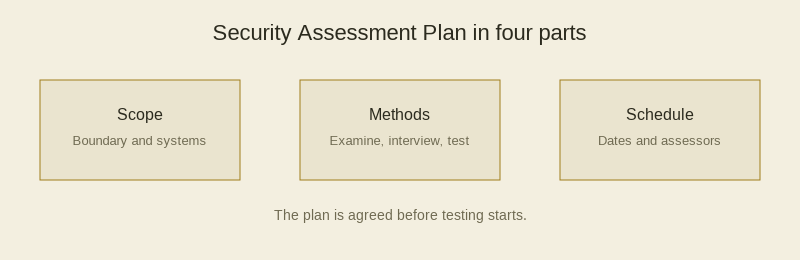
Federal Risk and Authorization Management Program (FedRAMP) is the government program that authorizes cloud services. A Security Assessment Plan (SAP) is the written plan for testing a cloud service. The plan describes the scope, the methods, and the schedule for the assessment.
Who writes the plan
The independent assessor writes the SAP. The assessor is called a Third Party Assessment Organization (3PAO). The 3PAO must be independent from the cloud service provider. The provider supplies facts, diagrams, and system access. The 3PAO decides what to test and how to test it.
This split matters. The provider cannot grade its own work. The 3PAO cannot test what it does not understand. Both sides review the draft plan before testing starts. The agency that sponsors the authorization also reviews it when the path requires that review.
What the plan must cover
First, the plan states the scope. Scope means the boundary of the service under test. It lists the systems, the data flows, and the locations in scope. It also lists what sits outside the boundary and why.
Second, the plan lists the controls under test. Controls come from the FedRAMP baseline that fits the service. Baselines are Low, Moderate, or High. Each control gets a test method: examine, interview, or test. Examine means reading records. Interview means asking staff. Test means checking the control in action.
Third, the plan names the people and the tools. It lists the assessors and their roles. It lists the tools used for scanning and sampling. It states how evidence will be collected and stored.
Fourth, the plan sets the schedule. It gives dates for interviews, testing, and evidence review. It gives the date for the draft report. A schedule with no slack fails when one interview slips. Build in buffer days for retests.
What a weak plan looks like
A weak plan lists controls with no method for each one. A weak plan leaves the boundary vague. A weak plan gives one date for all testing, with no order. Each weakness leads to rework during testing. Rework during testing costs more than fixing the plan first.
Ask these questions before you sign the plan. Does each control have a method? Does the boundary match the system diagram? Are all data flows in scope? Are interview staff named? Are retest days included? If any answer is no, send the plan back for revision.
What the provider must prepare
Gather the system security plan and the boundary diagram. Gather the control implementation statements for each control. Gather the evidence index that points to each record. Brief the staff who will be interviewed. Staff should describe the real process, not the ideal one. Assessors test what staff describe, so the description must match the records.
Sources
- FedRAMP Authorization Process, Federal Risk and Authorization Management Program.
- FedRAMP Security Assessment Framework, Federal Risk and Authorization Management Program.
- NIST SP 800-53A Revision 5, National Institute of Standards and Technology.
- Original diagram by PolicyCortex.
Next step
This site explains FedRAMP as an independent guide. It is not a claim about any company authorization. To see how evidence is collected from live systems, visit PolicyCortex.