Questions / Answer
What Is the FedRAMP Incident Reporting Timeline After a Security Event?
A security event in a cloud service leaves almost no time to report it. FedRAMP expects the provider to tell stakeholders fast, before the full picture is known. A provider that waits for certainty will miss the deadline.
FedRAMP means Federal Risk and Authorization Management Program. CSP means cloud service provider. CISA means Cybersecurity and Infrastructure Security Agency. The FedRAMP Continuous Monitoring Playbook sets the reporting rule for authorized services. This article explains FedRAMP only. It makes no claim about any company authorization status.
The one hour rule
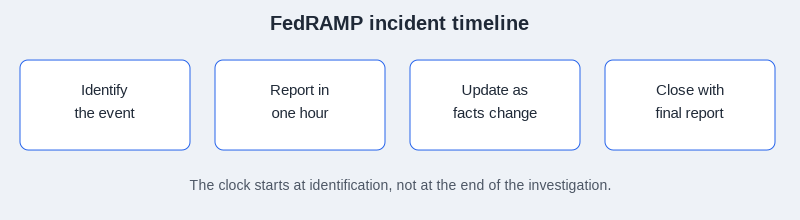
A provider must report suspected and confirmed incidents within one hour. The clock starts when the top response team identifies the event. It does not start when the investigation ends. Suspected events count, not just confirmed ones.
Report to four groups. First, customers who are impacted or may be impacted. Second, CISA, when the attack type falls under federal reporting guidance. Third, FedRAMP itself. Fourth, agency points of contact, including authorizing officials and agency response teams.
Use approved channels for sensitive details. Do not send incident details over open email. The playbook points providers to the secure repository for customer notices and to the federal reporting form for CISA.
The three reports
An incident moves through three reports. The Initial Incident Report opens the case. It gives what is known, what is suspected, and what is being done. The Ongoing Incident Report updates the case as facts change. The Final Incident Report closes the case after recovery.
Each update should change the picture. Repeat the first report with no new facts, and stakeholders cannot plan. Give new scope, new impact, or new recovery steps in each update.
Why the timeline is changing
FedRAMP has published updated incident communications timeframes that vary by service class and impact. The new approach replaces one flat deadline with tiered deadlines. Higher impact services face shorter deadlines. Lower impact services face longer ones.
Check which version applies to your service before an incident hits. A provider under a legacy agreement may still follow the older rule. A provider under the new approach must build faster triage. Either way, the work is the same: detect fast, judge impact fast, and send the first notice fast.
How to be ready in one hour
First, prewrite the notice template. Leave blanks for time, scope, and impact only. Second, keep the stakeholder list current. A stale contact list burns the hour. Third, rehearse with a fake event twice a year. Time the run from detection to sent notice. If the run takes over an hour, fix the slow step now.
Sources
- FedRAMP Continuous Monitoring Playbook.
- FedRAMP notice on updated incident communications procedures.
- NIST SP 800-53 Revision 5.
- Original diagram by PolicyCortex.
Next step
Want evidence tied to each control from live systems? See how PolicyCortex collects it.